digital marketing vs traditional marketing.
Digital Marketing vs Traditional Marketing: Which One Is Better?
Introduction
Marketing is an important part of every business because it helps brands reach the right audience and communicate their value. Today, businesses can promote their products through websites, social media, search engines, emails, TV, newspapers, radio, and many other channels. This creates an important question: digital marketing vs traditional marketing — which approach is better?
The answer depends on the business, target audience, budget, goals, and type of product or service. Digital marketing uses online platforms to reach customers, while traditional marketing mainly uses offline channels. Understanding both methods can help businesses choose a strategy that fits their needs.
What Is Digital Marketing?
Digital marketing refers to promoting products, services, or brands through online channels. It allows businesses to connect with customers using platforms they already use on the internet.
Common examples include:
Search engine optimization (SEO)
Social media marketing
Email marketing
Content marketing
Google Ads and other paid advertising
Influencer marketing
Video marketing
One major advantage of online promotion is that businesses can measure many activities through clicks, impressions, traffic, engagement, leads, and conversions. This makes it easier to understand how people interact with a campaign.
For example, a small business can create a website, publish useful content, and use social media to reach potential customers without depending entirely on expensive offline advertising.
What Is Traditional Marketing?
Traditional marketing includes promotional methods that existed before the growth of the internet. These methods are still used by many businesses to reach local and mass audiences.
Examples include:
Television advertisements
Radio advertisements
Newspapers and magazines
Billboards
Flyers and brochures
Direct mail
Outdoor advertising
Traditional methods can be useful when a business wants to create strong local awareness or reach people who may not spend much time online.
For example, a local restaurant may use posters, flyers, and roadside signage to attract people living nearby. These methods can provide visibility in a specific geographic area.
Digital Marketing vs Traditional Marketing: Key Differences
The biggest difference between these two approaches is the medium used to communicate with customers.
| Factor | Digital Marketing | Traditional Marketing |
|---|---|---|
| Medium | Internet and digital platforms | Offline media |
| Audience targeting | Usually more specific | Often broader |
| Measurement | Detailed tracking is generally available | Measurement can be more difficult |
| Interaction | Two-way and interactive | Often one-way |
| Geographic reach | Local to global | Local, regional, or mass |
| Campaign changes | Usually easier to modify | Changes may take more time |
| Content formats | Videos, blogs, posts, emails, ads | TV, print, radio, outdoor ads |
The choice should not be based only on which method appears more modern. Businesses should consider where their audience spends time and which channel can deliver the desired result.
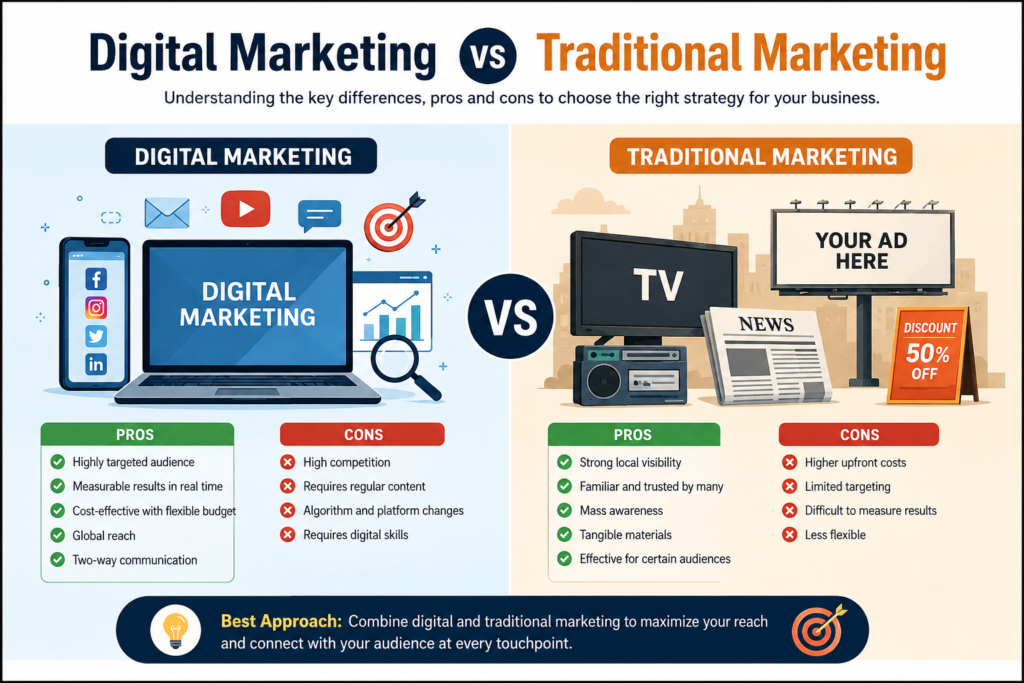
Digital Marketing vs Traditional Marketing Pros and Cons
Understanding the digital marketing vs traditional marketing pros and cons can make the decision easier.
Pros of Digital Marketing
1. Better audience targeting
Online platforms can provide different targeting options, allowing businesses to focus campaigns on particular audiences.
2. Easy performance tracking
Businesses can monitor metrics such as website visits, clicks, engagement, leads, and conversions.
3. Flexible budgets
Many online advertising platforms allow businesses to start with smaller budgets and adjust campaigns according to performance.
4. Global reach
A business can potentially reach customers outside its local area through websites, search engines, and social platforms.
5. Direct engagement
Customers can comment, share, message, review, or otherwise interact with brands online.
Cons of Digital Marketing
1. High competition
Because many businesses use online platforms, getting attention can be challenging.
2. Requires continuous content
Websites and social profiles often need regular, useful, and relevant content.
3. Platform changes
Search engines and social media platforms can change their algorithms, features, or advertising systems.
4. Requires digital skills
Businesses may need knowledge of SEO, analytics, advertising, content creation, or social media management.
Pros of Traditional Marketing
1. Strong local visibility
Print advertisements, billboards, radio, and flyers can work well for businesses targeting a particular location.
2. Familiar to many audiences
Traditional channels remain recognizable and accessible to a wide range of people.
3. Physical presence
Brochures, business cards, and printed materials can give customers something tangible to keep.
4. Useful for mass awareness
Television, radio, and outdoor advertising can expose a message to a large audience.
Cons of Traditional Marketing
1. Higher upfront costs
Television, print, and outdoor campaigns can require significant investment.
2. Limited targeting
Compared with many online platforms, traditional channels may provide fewer precise targeting options.
3. Difficult measurement
It can be harder to determine exactly how many people saw an offline advertisement and then became customers.
4. Less flexibility
Once a newspaper advertisement is printed or a billboard campaign is launched, making changes may be more difficult.
Which Marketing Method Should You Choose?
There is no universal winner in the digital marketing vs traditional marketing comparison. The right option depends on your business objectives.
If your audience spends considerable time online and you want measurable campaigns, digital channels may be a strong choice. SEO, social media, email, and online advertising can help businesses build visibility and communicate directly with potential customers.
On the other hand, traditional methods can be valuable for local businesses, events, and campaigns designed to reach audiences through television, radio, print, or outdoor media.
In many cases, combining both approaches can be more effective. For example, a business could use a local billboard to create awareness and then direct people to its website through a simple call to action. This connects offline visibility with online engagement.
How Digital and Traditional Marketing Work Together
Instead of treating these approaches as competitors, businesses can use them as complementary channels.
Consider a new local clothing store. It could distribute flyers in nearby areas, use outdoor signage, create an Instagram presence, and publish helpful content on its website. The offline campaign can create local awareness, while digital channels can help customers discover products and communicate with the business.
This integrated approach can create a smoother customer journey. Someone might first notice a traditional advertisement and later search for the brand online before making a purchase.
Conclusion
The digital marketing vs traditional marketing decision depends on the audience, business goals, budget, location, and campaign requirements. Digital methods offer flexibility, measurable performance, targeting, and online interaction. Traditional methods can provide strong offline visibility, physical presence, and broad local awareness.
Rather than choosing one method automatically, businesses should understand the strengths and limitations of both. A well-planned strategy can combine online and offline channels to reach customers at different stages of their journey.
CTA: Build a Smarter Marketing Strategy
Ready to improve your marketing strategy? Start by understanding your target audience, defining clear goals, and selecting the channels that match your business. Whether you choose online methods, offline promotion, or a combination of both, focus on providing useful information and creating meaningful customer experiences.