SEO vs Social Media Marketing
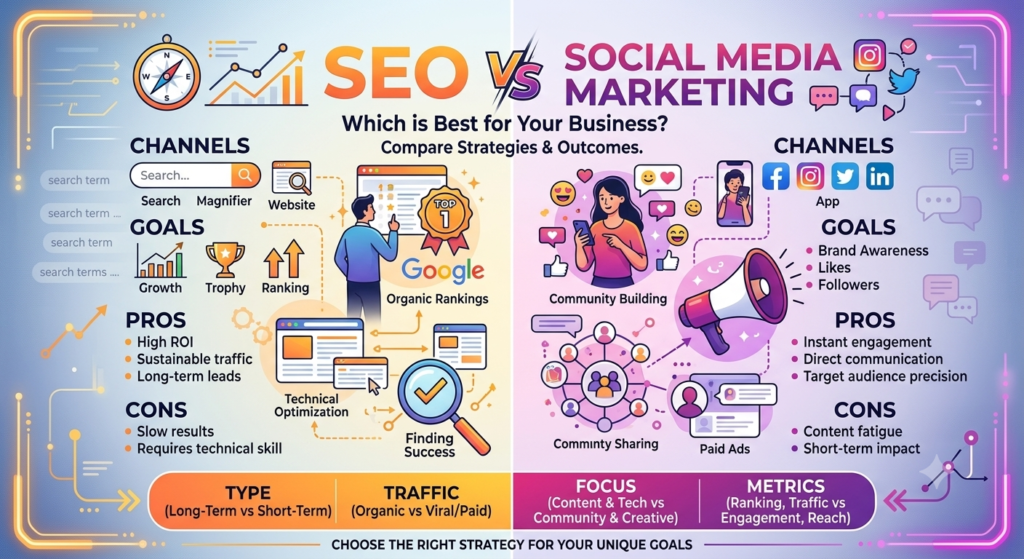
SEO vs Social Media Marketing: Which One Is Better for Your Business?
Introduction
In today’s digital world, businesses need a strong online presence to reach the right audience. Two popular strategies that help brands grow online are SEO and social media marketing. Both can increase visibility, attract visitors, and support business growth, but they work in different ways.
If you are confused about SEO vs Social Media Marketing, this guide will help you understand their differences, benefits, limitations, and ideal use cases. SEO mainly focuses on improving a website’s visibility in search engines, while social media marketing focuses on connecting with audiences through social platforms.
Understanding both strategies can help you choose the right approach according to your goals, audience, budget, and content strategy.
What Is SEO?
SEO, or Search Engine Optimization, is the process of improving a website so that it can appear more prominently in search engine results.
For example, when someone searches for “best digital marketing agency,” search engines analyze many factors before displaying results. A website with useful content, relevant keywords, good technical performance, and a strong user experience has a better opportunity to appear for relevant searches.
SEO generally includes areas such as:
- Keyword research
- Helpful and relevant content
- On-page optimization
- Technical SEO
- Internal linking
- Website speed and usability
- Off-page signals and backlinks
The major advantage of SEO is that it can bring organic traffic without requiring payment for every individual click.
What Is Social Media Marketing?
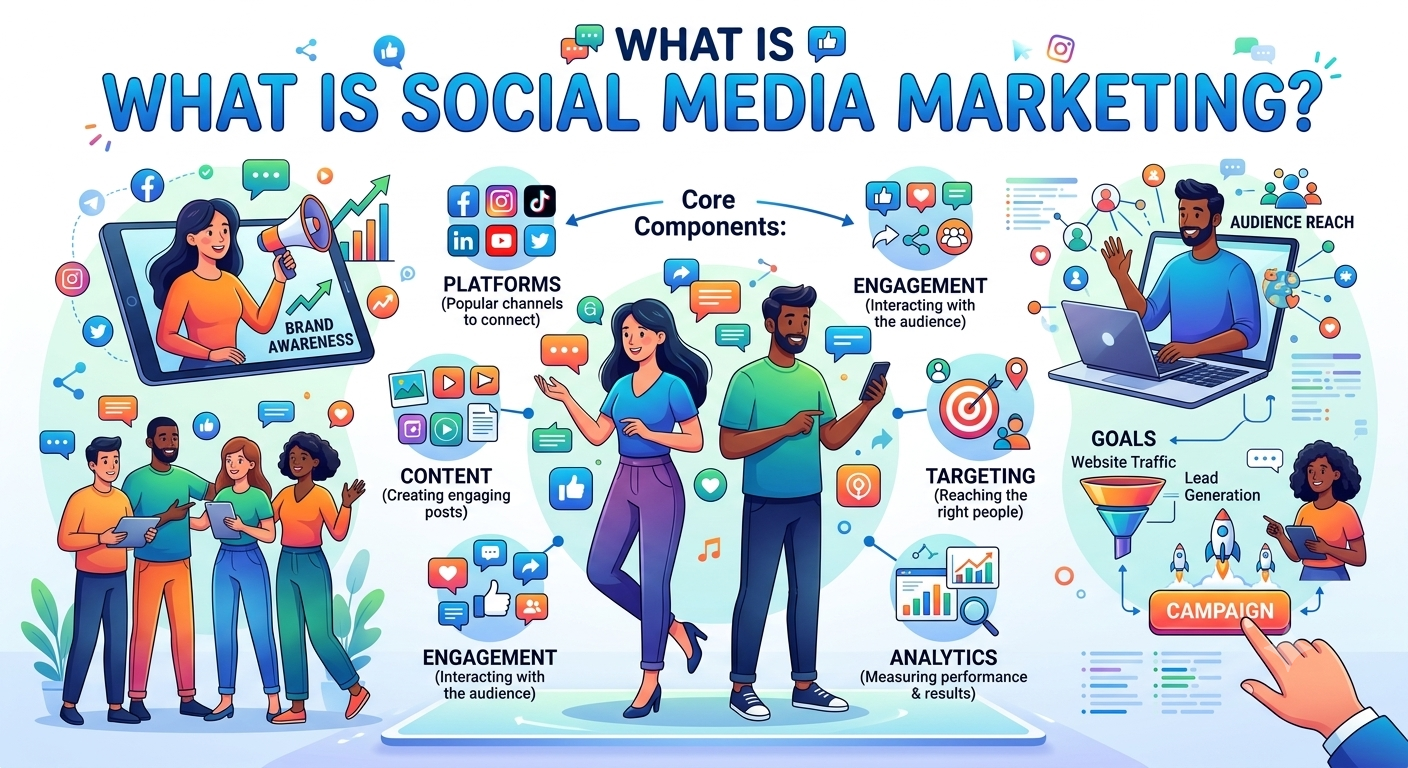
Social media marketing means using social platforms to promote content, communicate with audiences, build brand awareness, and support business goals.
Platforms such as Instagram, Facebook, LinkedIn, YouTube, and other social networks allow businesses to share different types of content, including:
- Short videos
- Images and graphics
- Educational posts
- Stories
- Product updates
- Polls and discussions
- Customer-focused content
Unlike search traffic, where users often have a specific query or problem, social media can help brands reach people while they are discovering, consuming, and sharing content.
This makes social platforms especially useful for building relationships and creating ongoing engagement.
SEO vs Social Media Marketing: Key Difference
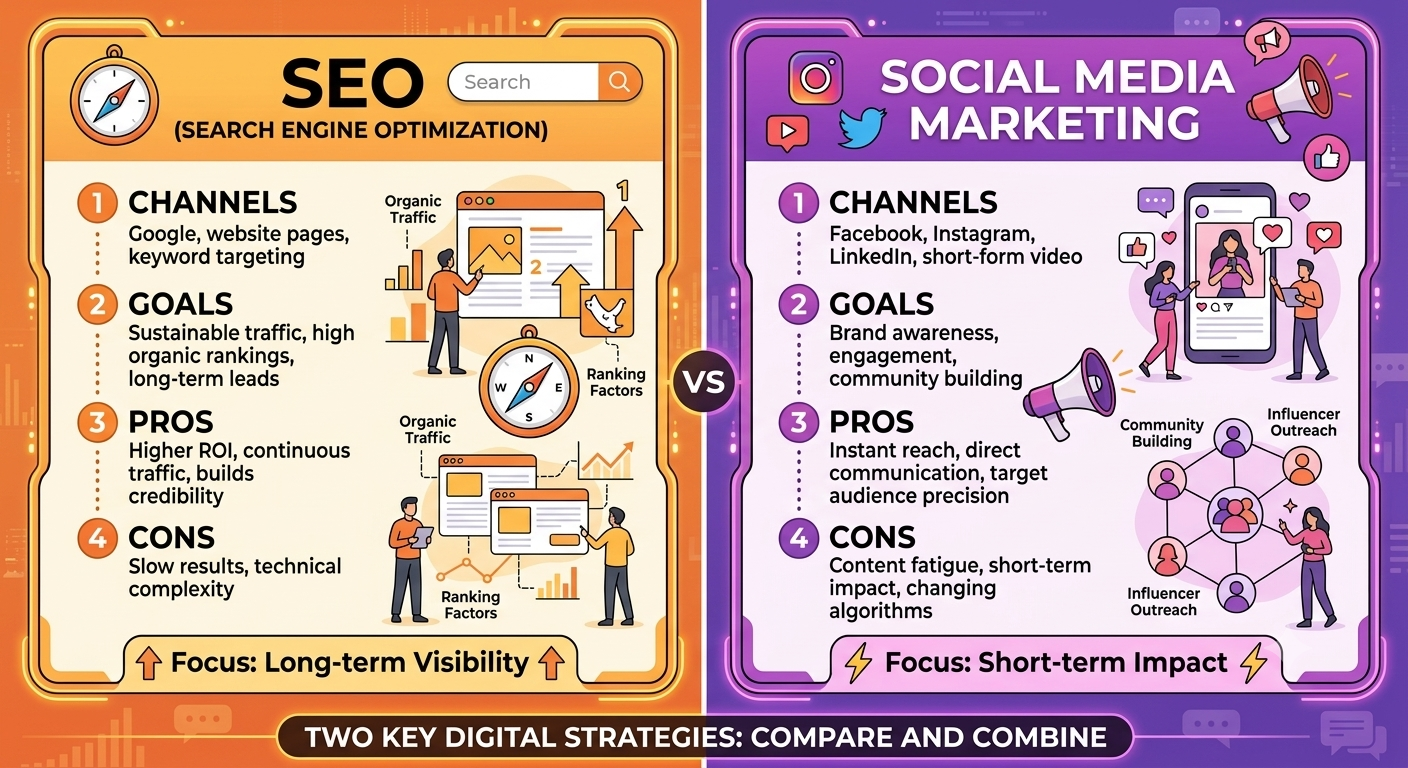
The biggest difference is the way people discover your content.
SEO usually targets people who are actively searching for information, products, or solutions. Social media, on the other hand, can introduce your content to people based on their interests, behavior, connections, or interactions.
Here is a simple comparison:
| Factor | SEO | Social Media Marketing |
|---|---|---|
| Main purpose | Search visibility | Audience engagement |
| Traffic type | Mainly organic search traffic | Social and referral traffic |
| Audience intent | Often higher search intent | Discovery and engagement |
| Content lifespan | Can remain useful for a long time | Often shorter-lived |
| Relationship building | Indirect | Strong and direct |
| Results | Usually gradual | Can be quicker for engagement |
| Best for | Search visibility and long-term traffic | Awareness and community |
Neither approach is automatically better. The right choice depends on what you want to achieve.
SEO vs Social Media Marketing Pros and Cons
Understanding the SEO vs Social Media Marketing pros and cons can make your decision easier.
Pros of SEO
1. Long-term traffic potential
A well-optimized page can continue attracting visitors from search engines for an extended period.
2. Strong search intent
People searching for specific information often already have a problem, question, or requirement in mind.
3. Builds website visibility
SEO helps businesses develop a searchable online presence around relevant topics.
4. Supports content marketing
Blog posts, guides, landing pages, and educational resources can all contribute to an SEO strategy.
Cons of SEO
1. Results can take time
SEO is generally a long-term strategy. New websites may need time to build authority and visibility.
2. Requires continuous optimization
Search behavior, competitors, content quality, and search engine systems can change, so websites need regular improvement.
3. Competition can be high
Popular keywords can have many websites competing for the same search results.
Pros of Social Media Marketing
1. Fast content distribution
A social post can reach an audience shortly after publication, especially when users interact with and share it.
2. Strong engagement
Comments, messages, reactions, shares, and discussions allow businesses to interact directly with their audience.
3. Excellent for brand awareness
Creative content can introduce a brand to people who may not be actively searching for it.
4. Easy content repurposing
One blog can become multiple social posts, short videos, carousels, or discussion topics.
Cons of Social Media Marketing
1. Content can have a short lifespan
A post may receive most of its engagement within a limited period before newer content replaces it in users’ feeds.
2. Platform dependency
Businesses depend on the features, algorithms, and audience behavior of the platforms they use.
3. Consistent content is important
Maintaining visibility often requires regular publishing and audience interaction.
Which Strategy Should You Choose?
The answer depends on your marketing objective.
If your main goal is to attract people who are actively searching for your products, services, or information, SEO can be a strong choice. It is particularly useful for blogs, service pages, product pages, and educational content.
If your priority is building brand awareness, engaging with customers, and creating a community, social media marketing may be more suitable.
For example, a digital marketing website can publish a detailed SEO guide to attract search traffic. The same guide can then be converted into LinkedIn posts, Instagram carousels, or short videos to reach social audiences.
This creates a connected content system instead of treating every marketing channel separately.
Can SEO and Social Media Marketing Work Together?
Yes. In fact, using both strategies can create a stronger digital marketing system.
Think of your website as the central content hub. You can publish a useful article on your website and optimize it for relevant search queries. After that, you can distribute the same idea across social platforms.
For example:
Main Topic: Digital Marketing
Supporting Topics:
- SEO
- Social Media Marketing
- Google Ads
- Email Marketing
- Content Marketing
This follows a connected content approach where one broad subject leads to several related topics. Such organization makes content planning easier and gives readers multiple ways to explore a subject.
The same concept can be applied to marketing channels. Search can help people discover your website, while social platforms can help you distribute content and maintain audience engagement.
SEO vs Social Media Marketing for Beginners
Beginners should avoid trying to master every platform and strategy at once. Start by defining one clear goal.
If you want to build a long-term website presence, begin with useful, well-organized content and basic SEO. Research the questions your audience is searching for and create pages that genuinely answer those questions.
If your goal is audience engagement, choose one or two social platforms where your target audience is active. Focus on useful and consistent content instead of simply posting promotional messages.
You can later connect both strategies as your content library grows.
A simple approach is:
Choose a main topic → Create useful content → Optimize it → Share it on social platforms → Connect related content → Improve over time
SEO or Social Media Marketing?
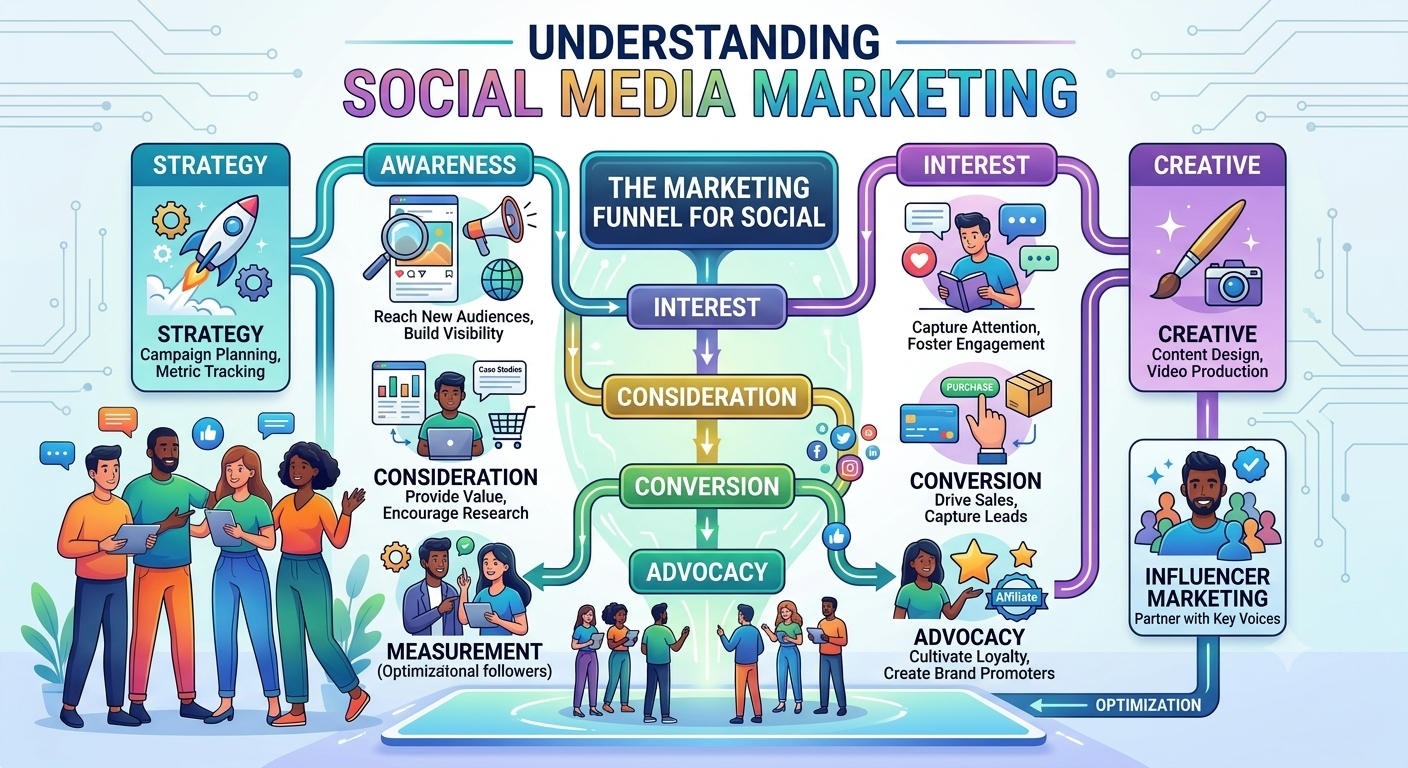
The SEO vs Social Media Marketing debate does not have one universal winner. Both strategies serve different purposes.
SEO is valuable for long-term search visibility, organic traffic, and capturing people with specific search intent. Social media marketing is powerful for audience engagement, brand awareness, content distribution, and community building.
For many businesses, the smartest approach is not choosing one and ignoring the other. Instead, use SEO to build a strong searchable content foundation and social media to distribute that content and connect with your audience.
A well-planned strategy should focus on creating useful, connected content rather than publishing random topics. When your website content and social media activities support the same main subject, your audience gets a clearer and more useful journey.
Build a Stronger Digital Marketing Strategy
Ready to improve your online presence? Start by choosing one important topic, create useful supporting content around it, and connect your website strategy with social media distribution.
Whether you start with SEO, social media, or both, focus on helpful content, consistent publishing, and a clear audience goal. Small, connected improvements can create a stronger digital marketing foundation over time.